

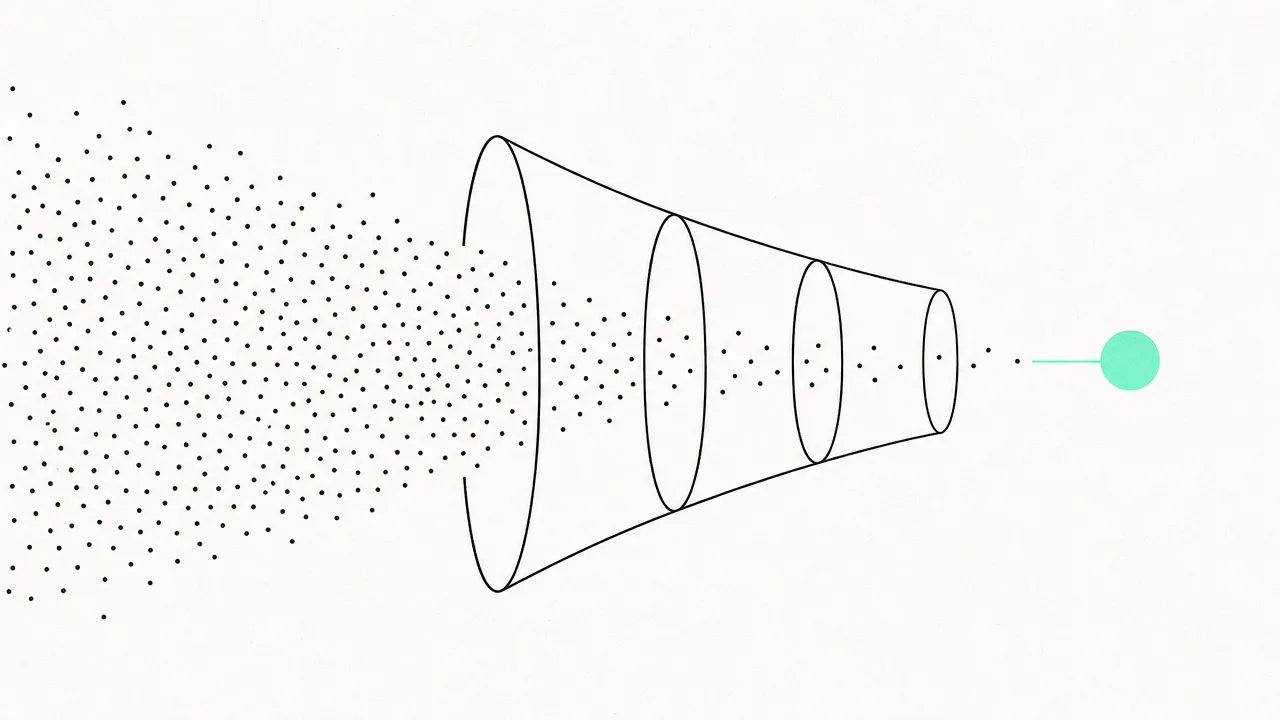
Radar does not keyword-match Reddit and fire off a template. It reads your site into a product brief, labels every candidate community from that community's real rules and its real recent post titles, screens and scores individual threads against the brief, checks whether the thread is worth showing up for outside Reddit too, and only then drafts a reply in your voice, one that a validator checks line by line before you ever see it. Nothing posts itself. You read the draft, edit it if you want, and paste it yourself under your own account. This is a walk through every stage, with the actual rubric wording the pipeline runs on.
I built Radar to answer one question: how do you find Reddit threads to promote your product without guessing wrong and getting banned for it.
The wrong thread is the ban
The score prompt that reads every thread puts it plainly: a founder who replies to the wrong thread looks like spam and gets banned, and a founder who misses the right thread loses a customer who was asking for exactly their product. One mistake costs an account. The other costs a sale you'll never know you missed, because you never saw the thread.
Most tools that find "Reddit leads" solve half of this. They match a keyword against a firehose of posts and hand you a list, volume, not judgment. That can't tell someone asking for a tool like yours from someone using the same word in a different context, and it can't tell you whether the subreddit will ban you for answering. Reddit lead scoring only means something if the score reflects both: does this poster need what you built, and is this a place where saying so won't get you removed.
Every stage below exists because skipping it produces one of those two mistakes.
Read the site into a product brief
A scan starts with your site URL. Radar reads the page and builds a product brief: name, category, audience, what it does and what it doesn't. An overclaiming reply is the first thing that gets a founder caught, so constraints matter.
From that brief, Radar discovers candidate subreddits: web search, Reddit search by topic, articles listing relevant subreddits, and a fixed list of launch and feedback venues that allow a pitch. The best-fit places for an early product, communities built for people to show what they're building, often don't turn up from a topic search. This stage produces the brief and a list of communities worth checking, nothing scored yet.
Label every community from its real rules and 30 real post titles
For every live candidate, one model call reads the product brief, that subreddit's posted rules fetched through a data provider, and up to 30 real post titles from the last two weeks. It returns two judgments: a fit label for this specific product, and a promo policy read from the rules alone.
The four fit labels, in the pipeline's own wording:
- promote: the rules allow a disclosed founder to present their product, and either members ask for tool recommendations or compare products for the problem this one solves, or the community exists for launches, showcases, feedback or beta testing in this product's domain.
- soft: members discuss the problems this product solves, so a helpful answer can mention the product once with disclosure, or the rules restrict promotion to that kind of answer.
- hang: the members are this product's audience, so the founder belongs in the room, but the specific problems rarely come up in the titles, or a mention would be off-topic or against the rules.
- skip: the members aren't this product's audience. The name or topic only sounded related.
The four promo policies, read from the rules alone:
- allowed: nothing in the rules stops a disclosed, helpful comment that names a product once.
- restricted: allowed only under conditions beyond disclosure, a flair requirement, a participation ratio, mod approval, a specific day.
- banned: promotion is prohibited outright, or confined to a designated thread.
- unknown: no rules and no sidebar description to judge from. Missing evidence never counts as permission.
Titles matter more than the subreddit's name because a name is a guess and 30 recent posts are evidence. r/marketing sounds like a fit for almost any product until you read its rules (self-promotion and shilling are both prohibited) and see what people actually post. The audience rule works the same way: who the members are, not what they talk about. A library for developers who write code isn't a no-code tool's audience even if a thread mentions no-code in passing; a community made up of a product's actual buyers is never a skip just because recent titles cover something else.
There's a cap on both labels: a "promote" fit paired with a "banned" policy gets pulled down to "soft" or "hang". The community may be the right audience, but rules that forbid promotion win. Rules and policy are cached for seven days, so the same subreddit isn't re-read on every scan.
The database behind this label has been running since Radar's repository started on 5 September 2026. As of 2026-09-14, across 999 subreddits audited, 742 had posted rules and the rest were judged from the sidebar. Of the subreddits with evidence to judge from, close to half come back banned, another third restricted, only about a fifth allowed outright. r/startups, r/smallbusiness, r/webdev and r/sales read as banned once you see their rules; r/saas and r/indiehackers read as restricted, allowed only inside a specific format; r/sideproject and r/buildinpublic read as allowed. This is why the stage runs before any thread gets scored.
Screen: 20 posts, yes, maybe, no
Once a subreddit is labeled, Radar pulls its recent posts through a quick first-pass model, 20 posts per call, title and body. For each one it answers one question: could the founder usefully reply?
- yes: the poster asks for a tool, a recommendation, a comparison, or describes a problem this product solves, and they're someone who'd use it.
- maybe: the topic is close, the need is implied, or the poster's situation is unclear.
- no: different need, different audience, a showcase of the poster's own product, a job post, news, a joke, or the product can't help.
Yes and maybe move on. A "no" is remembered, so the post is never read again for this product. The pass is fast, cheap, and willing to say "maybe" when uncertain rather than missing a real thread.
Score: the 0-100 rubric
Threads that survive the screen go to a stronger model, one post at a time, with the full brief and the community's fit label attached. The rubric is explicit:
- 90-100: the poster asks for a tool or recommendation that this product is, or describes this product's exact job and says they want a solution.
- 75-89: the poster has a problem this product solves, and would use it given who they are; they did not ask for a tool.
- 60-74: adjacent, the problem is nearby or only part of the post; a reply can help and mention the product once, naturally.
- 0-59: the product would not help this poster, or they are not its audience, or the post is a showcase, a job, news or a rant with nothing to answer.
Every scored thread also comes back with four short outputs a founder reads before deciding to reply:
- need, one plain sentence stating the poster's underlying goal, no product name. The prompt's own example: "Real-time signup attribution on launch day without GA4 complexity."
- why, a short line quoting the two or three words in the post that show the need, paired with who the poster is, so you can trust the score without rereading the thread.
- angle, one sentence on what a reply must do first to be useful, and whether naming the product even fits. In a hang community it never does.
- query, three to six lowercase words a stranger would type into Google for this problem, no product name, no subreddit, something like "lightweight analytics for saas launch".
Threads that score under 60 never reach the inbox. What does reach it is capped too: the inbox holds the 30 best-fit threads from the last 14 days, refreshed every six hours, a short list worth reading rather than a queue that grows forever.
Visibility: does the thread keep working
A reply posted today isn't done working the day you post it. A good comment under a question that ranks on Google keeps bringing people to it for months, so Radar checks, per thread: its Google rank for the question behind it, that question's monthly search volume, and whether Perplexity cites the thread, checked only for threads Google already ranks in the top 20. All of it is rechecked every seven days.
That's the layer that turns a Reddit comment into more than a one-time interaction: a thread with real search volume, ranking well, and getting cited by an AI answer engine is still doing work long after the thread itself has gone quiet.
Draft: tone, length, and a founder's voice
Drafting happens only when you ask for it, one model call per thread. You pick a tone and a length; the model writes to both.
Tones: Helpful (tips first, the product as an aside), Personal story (what you tried yourself, told in the first person), Straight answer (the answer in the first line, then the reasoning, no warm-up). Lengths: short, 40 to 80 words, or medium, 80 to 150.
Voice rules underneath every draft: answer the actual question first, reference a concrete detail from the post so the reply couldn't be pasted under any other thread, never greet by username, plain text with no markdown, no emoji, no dashes standing in for commas, and never the line "Hope this helps."
If the product comes up at all, disclosure is the only honest framing, something like "full disclosure, I built this," never posing as an unaffiliated happy user. The mention, if there is one, appears once, only in the final third, after the actual help is delivered. In a promote community, the bare URL appears exactly once, inside that disclosure sentence. In a soft community, the mention happens once with disclosure and no link unless you asked for one. In a hang community, the product is never named. And regardless of fit label: never a price, a plan, a trial length, or a word about how the reply itself was produced.
The check before you see it
Every draft gets checked by a validator, in code, before it reaches your screen. Fail a check and the specific reason gets fed straight back to the model for a rewrite, up to three attempts.
| Rule | What triggers a rewrite |
|---|---|
| Disclosure only | claims to be an unaffiliated user or "no affiliation" |
| Mention timing | the product is named before the final third |
| Bare URL required | a promote-community reply names the product but never writes its URL |
| Hang stays silent | the product is named at all in a hang-labeled community |
| Only the product's own address | any web address where no link is allowed, or a domain that isn't the product's own |
| Word count | the reply lands far enough outside the requested range |
| Plain paragraphs | headings, bullet lists, or markdown formatting show up |
| No price | a price, a plan, or a trial length is stated anywhere |
| No self-reference | the reply mentions being drafted, AI-generated, or found by a tool |
| Fact check | a sentence naming the product claims something the site's facts don't support, or states a number or cadence not in those facts word for word |
Every sentence naming the product has to share vocabulary with something the brief says, not just plausible marketing language. Any number in that sentence, a price, a limit, a "once a week," has to appear in the facts verbatim, or the draft gets rejected and rewritten with the reason attached.
What it will not do
Radar never posts anything. There's no OAuth connection to your account, no login, no rented accounts, no bots; it reads Reddit through licensed commercial data providers, not the official API, and every reply gets pasted by you, under your own username.
There are no reply quotas. Volume quotas sell ban fuel: a pack of hundreds of replies pushes you to empty every vaguely related thread, and Reddit notices. Fit beats volume.
Hang communities never get a pitch, only help. It's one pitch per subreddit, then a cooldown. The reply never names the product in hang communities, discloses the founder wherever the rules ask for it, and roughly half of the replies Radar drafts never pitch the product at all. I wrote more about what counts as self-promotion in what Reddit's self-promotion rules say.
Why you still read every reply
None of this makes the founder optional. Read the need, the why, the angle before asking for a draft. Read the draft after it clears the validator. Decide whether it's you before you paste it anywhere.
I sell Radar with Radar. Every reply on the landing page was found and drafted by this pipeline and posted by me, by hand: a SHIP FM reply where I disclosed I built it, a ColorHer reply that helped and pitched nothing, a Radar reply where the sub's rules meant the link only went by DM. The paste is the product. Radar's job is to make sure you're pasting something worth pasting, not to paste it for you.
If you want to see what it finds for your own site, scan my site free. I wrote about why I built it this way and the two bans that started it in why I built Radar, and how a tool finds Reddit threads without touching Reddit's official API in finding Reddit threads without the Reddit API.
FAQ
How do I find Reddit threads to promote my product without getting banned?
Read the subreddit's actual rules before you post, not just its name, and disclose that you're the founder whenever you mention your product. Radar automates exactly that: it labels each community from its real rules and recent post titles first, then only surfaces threads inside communities where a disclosed mention is allowed.
Does Radar log into my Reddit account or post anything for me?
No. Radar doesn't use Reddit's official API and doesn't log into your account; it reads Reddit through licensed commercial data providers. You read every draft and paste it yourself, under your own username. Nothing is ever posted automatically.
How does Reddit thread scoring work?
Each thread that survives an initial yes/maybe/no screen is read in full by a stronger model that returns a 0 to 100 score against a fixed rubric, from "asks for a tool exactly like this" at the top down to "wrong audience or not a real question" at the bottom, plus the poster's need, why it fits, and the angle a reply should take. Threads scoring under 60 never reach the inbox.
What does the AI Reddit reply drafter write, and can I trust it?
It writes one reply per thread, in a tone and length you pick, using only facts your own site states. A validator checks every draft before you see it, rejecting fabricated claims, prices, self-promotion in the wrong place, and anything that reveals the reply was drafted by a tool, then sends the reason back for a rewrite.
Is this different from Reddit lead scoring tools that just match keywords?
Yes. A keyword match can't tell whether a subreddit's rules allow a pitch, or whether the poster is really the product's audience versus someone who used a similar word. Radar labels the community's real rules and audience first, screens individual posts for genuine fit, then scores only what's left, so a thread in your inbox has cleared both checks, not just a keyword filter.